Apple

Blog posts tagged with Apple
Apple Expo 2002 - Paris

Apple Expo 2002 - Paris

04/10/2002
European Apple fans have been eagerly awaiting this year's Apple Expo. As last year's event was cancelled, and most could not really warrant the cost of travelling to America, this year's Expo was the first major Apple-related date for Europeans in two years. There were of course a lot of product releases and newsworthy events at the Expo this year but attempting to document them all would be nigh on impossible, so I will now try to present my own personal highlights.
Mac Expo 2002 - London

Mac Expo 2002 - London

15/11/2002
There was excitement and enthusiasm in the air of MacExpo 2001, and there was a reason. Perhaps because Apple was exhibiting at a UK show for the first time in five years, or perhaps because Mac users currently have a lot to celebrate, there was one of the largest turnouts of visitors and exhibitors in the history of the show. In a time of economic downturn (especially in the computing market), Apple is one of the very few IT companies currently running at a profit. A major upgrade to an amazing new OS has been released, developers are flocking back to the Mac in droves, machines are increasing in power but decreasing in price, and now Apple has once again starting manufacturing non-Mac products. To top all that you can't move without seeing Macs featured in adverts, TV programs, or films, so there really is a lot to celebrate.
ThinkFree Office review

ThinkFree Office review

04/01/2003
To me Java is one of the most exciting and promising technologies of the past few years, but it's potential hasn't been reached in a lot of circles yet, especially in the consumer field. ThinkFree Office is an exceptional implementation of Java, being a multi platform MS Office compatible office suite. It runs on Windows Mac OS 9/X and varying flavours of UNIX, thus parts of the interface may seem a little un-Mac like but when you?re developing cross platform certain compromises must be taken. ThinkFree Office runs on a Java Virtual machine so is on occasions slower and more sluggish than other applications. The Microsoft Office compatibility is extremely well implemented, with the application not only reading / writing office files but even the layout and look & feel is similar, right down to dialogue boxes with similar appearances. There are of course some features missing and documents don't render exactly the same way as in Office, but for a reduction of £300 you can't really complain. For example the ThinkFree Show templates are different from PowerPoint templates, probably for legal reasons (!), meaning that some of you files will have to reedited to suit, complex tables look a little different, which may present problems for some users. On the plus side ThinkFree Writes web publishing tools are in my opinion better than MS Offices, it produces cleaner code and has the ability to insert more advanced objects such as image maps. The Excel beater, ThinkFree Calc has all that you would expect, a complex array of calculations and formulae, the ability to create a multitude of graphs (Though losing Excel v.X's support for transparency). The PowerPoint type module, ThinkFree Show is again more of what you would expect, Slide templates, animations, but no QuickTime support unfortunately.
Workswell review

Workswell review

04/01/2003
Drawwell is a stripped down version of Workswell, so lets take a quick look at it's feature first and then focus on the extras in Workswell. Drawwell is a vector based illustration and DTP application, providing a vast array of easy to create objects from squares to shape bursts and doughnuts. All are easily modifiable through an inspector panel where you can set position, size, colours and textual content. Drawwell is Cocoa based, so you get all the features associated with OS X native applications such as font and colour picker panels. Layers are available in Drawwell, as supposedly is transparency but I couldn't seem to find any in implementation of this. Workswell is fairly similar, but adds some extra merge features and drawing objects. The merging features are extensive to say the least, mainly offering integration with iApps such as iTunes and iPhoto (May be more support to come?). Within several clicks detailed documents can be created based on photo or music libraries including all information from EXIF and ID3 data such as contact sheets and CD inlays. Along with the support for iApp libraries logical comparisons, incremental values and sorting (among other things) can also be used in merge features. Support for iApps aside, there are other potential uses for Workswells feature set such as numbered tickets and graphs, all based around clear vector graphics.
Bring the power of Apple Shortcuts to Obsidian

Bring the power of Apple Shortcuts to Obsidian

13/12/2023
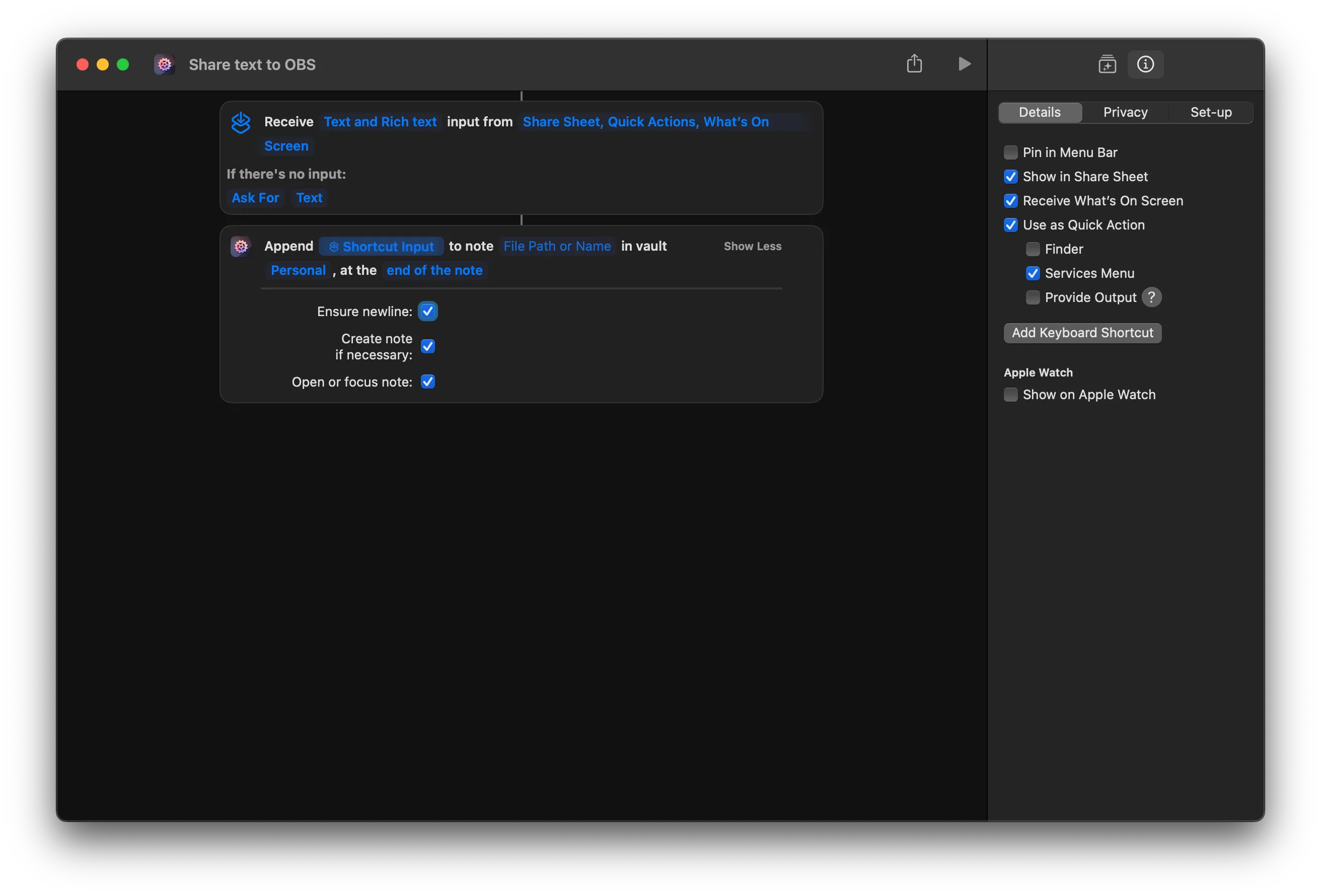
I've mentioned before that I have been using Obsidian more and more, and from a knowledge management perspective, it's fantastic, with a plethora of plugins that extend its functionality to connect to many external services. But as a cross-platform Electron application, integration with the host operating system is one of the places it fails. As the underlying data store is a folder of files, some integration is possible there, but Obsidian has minimal awareness of changes that happen.
Increasing focus with macOS Focus Modes and Raycast

Increasing focus with macOS Focus Modes and Raycast

05/10/2025
Surrounded by digital devices, it's all too easy to use any number of them to access a world of distractions, rather than focus on doing what you need to get done. In a strange, ironic twist, many of the devices and operating systems now offer tools to help block and filter these distractions. When I split myself between macOS and Android, I had focus modes set on both (conveniently, both OSs call them the same thing), but I never found them to be that effective, as I'd have to keep remembering to keep the equivalent modes the same on both devices. Then I bought an iPhone and discovered that the focus modes mostly sync between devices. With the arrival of the "Reduce Interruptions" focus mode in the 2024 operating systems, I went all in on optimising focus modes to work as efficiently as possible, not only blocking and filtering as many distractions as possible, but also automating them as much as possible.